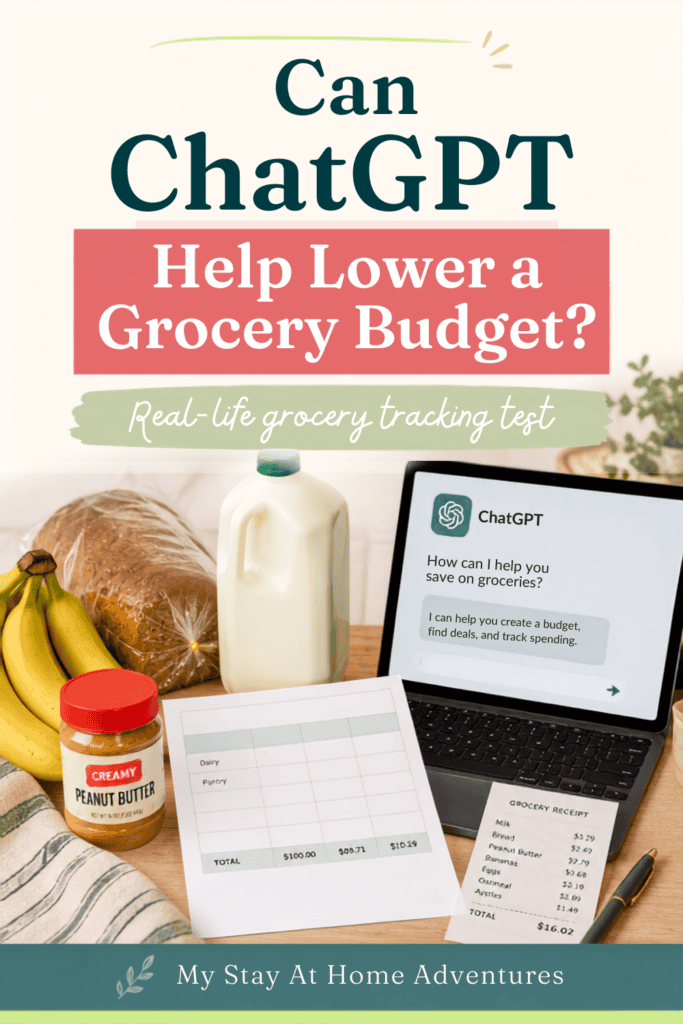
Can ChatGPT Help Lower a Grocery Budget?
This post may contain affiliate links which might earn us money. Please read my Disclosure and Privacy policies here
Using ChatGPT for a grocery budget might sound strange at first, especially if you are already tired of hearing about AI. I understand that. I have mixed feelings about AI too, especially with how it has affected websites, recipes, and the way people find information online. I am not writing this because I think AI is perfect, and I am not saying everyone needs to use it.
But I do think there is a difference between letting AI make decisions for you and using a tool to help you look at your own numbers more clearly. That is what I wanted to test.
I was already sharing my real-life grocery numbers with a free simple spreadsheet because I wanted to help people start tracking somewhere. Budgeting can feel overwhelming when you look at everything at once, so groceries felt like a practical place to begin. Most families understand grocery spending. Most of us have looked at a grocery total and wondered how it got so high. Most of us have felt like we need to cut back, but we do not always know where to start.
I also wanted to share real numbers from a real family. We are a family of five, and three of my children have special needs. That means our grocery budget is not going to look like everyone else’s, and that is okay. My goal was never to show a perfect budget. My goal was to show what tracking can look like in real life.
Then in June, I shared with my newsletter readers that I was going to test using ChatGPT with my grocery tracker. I wanted to see if it could help me understand my grocery spending better, catch mistakes, notice patterns, and maybe help me reduce what I was spending.
This post is about that test: how I used ChatGPT while shopping, how I used it while keeping track, what it helped me notice, and how you can try something similar with your own grocery budget.
Why Groceries Are a Good Place to Start
When people feel overwhelmed by budgeting, one of the first things they usually say is, “I need to cut groceries.” I understand why. Groceries are expensive, and they are something we have to buy again and again. You can have a plan, go to the store for a few things, and still come home with a receipt that feels higher than expected.
Groceries are also emotional. We are not just buying food. We are feeding our families, keeping snacks in the house, trying to make meals easier, dealing with picky eating, planning around busy days, and sometimes buying convenience because life is a lot. When you have a family, groceries are not always simple.
That is why I think groceries are a good first category to track. You do not have to fix your whole budget at once. You can start with one category that already shows up in your life every week. Once you start writing things down, you begin to see patterns faster than you would with a category you only spend in once in a while.
The goal is not to judge every item in the cart. The goal is to understand what is happening. If you do not track it, you are guessing. And when money is tight or you are trying to make better choices, guessing can get expensive.
Why I Use a Simple Grocery Spreadsheet
I like the idea of starting simple because a lot of people do not need another complicated budgeting system. They need a place to write down what they actually bought. That is why I shared a simple grocery spreadsheet. It gives you a way to track your spending without having to figure out your entire financial life in one sitting.
The spreadsheet is meant to help you see the basics: where you shopped, what you bought, how much it cost, and what category it belongs in. That last part matters because grocery receipts are not always just groceries. A Walmart or Sam’s receipt might include food, paper plates, wipes, pullups, cleaning supplies, personal care items, drinks, snacks, and household extras.
If all of that goes under “groceries,” your grocery total can look worse than it really is. Food may not be the only thing raising the total. Sometimes the issue is that household items and personal care items are hiding inside the grocery number.
Tracking helps you separate that. It lets you see what is food, what is household, what is personal care, and what belongs somewhere else. That does not make the spending disappear, but it helps you understand it better.
And that is the whole point. Before you can decide what to change, you need to know what you are actually doing.
Why I Tested ChatGPT With My Grocery Tracker
In June, I wanted to take the grocery tracker a step further and test ChatGPT with it. I wanted to see whether it could help me use the spreadsheet better. Not because ChatGPT knows my family better than I do. It does not. Not because I wanted AI to tell me what we should eat. I did not.
I wanted to see if it could help me ask better questions.
That is where ChatGPT became useful. It was like having a second set of eyes on the grocery list and the tracker. It helped me slow down when I was shopping, and it helped me review the numbers when I was keeping track.
This is important because a lot of grocery budgeting advice sounds easy until you are actually in the middle of shopping. It is easy to say “stick to the list,” but real life does not always work that neatly. Sometimes you remember something you forgot. Sometimes a child needs something. Sometimes you see a better price at another store. Sometimes you add an item because you are afraid of running out.
ChatGPT did not make those decisions for me. I still made the final choices. But it helped me pause long enough to think through what I was doing.
How I Used ChatGPT While Shopping and Keeping Track
The biggest thing I want people to understand is that I used ChatGPT in two ways. I used it while I was shopping, and I used it while I was keeping track.
While shopping, I used it to look at my list or cart and ask what could wait, what I should check for at home first, and what looked like a repeat purchase. This helped because online grocery carts can grow fast. You start with a few things you need, and before you know it, the cart has snacks, drinks, paper plates, household items, and things you may already have in the pantry.
While tracking, I used ChatGPT to look at the spreadsheet and help me catch mistakes or patterns. If a total looked too high, I could ask it what looked unusual. If an item seemed out of place, I could ask whether it should be grocery, household, personal care, or another category. If I kept buying the same item, I could ask it to help me see whether it was a true staple or something I was rebuying too soon.
Here is what that looked like in real life.
| What I was doing | How I used ChatGPT | Why it helped |
|---|---|---|
| Making a grocery list before shopping | I asked what looked like a true need, what could wait, and what I should check for at home first. | It helped me slow down before placing another order. |
| Building an online grocery cart | I used ChatGPT to question repeat items, extras, and things that did not need to be bought right away. | It helped me avoid shopping on autopilot. |
| Comparing Walmart, Sam’s, and Aldi | I used my list and tracker to think through which store made sense for certain items. | It reminded me that one store is not always cheaper for everything. |
| Looking at repeat purchases | I asked ChatGPT to look for items I kept buying, like peanut butter, milk, bread, bananas, jelly, and snacks. | It helped me see the difference between a regular staple and buying out of habit. |
| Looking at bulk purchases | I talked through whether a bulk item made sense or whether I was stocking up and then rebuying too soon. | It helped me remember that bulk buying only helps if I stop buying the same item again right away. |
| Updating the grocery tracker | I used ChatGPT when totals looked wrong or something did not make sense. | It helped me catch wrong dates, wrong quantities, and category mistakes. |
| Separating grocery and household spending | I asked what should count as groceries, household, personal care, or another budget category. | It made the grocery total more honest because not everything on a grocery receipt is food. |
| Planning around what was already at home | I used ChatGPT to help me think through pantry, fridge, and freezer items before shopping again. | It helped me use what I had instead of automatically buying more. |
This is why I think ChatGPT can be helpful when it is used correctly. It is not about letting AI run your budget. It is about using it to slow down and ask better questions before you spend more money.
What My Grocery Tracker Helped Me Notice
I do not want anyone to think tracking means you suddenly become perfect. That has not been my experience. What tracking does is show you things you may not notice when you are just shopping, putting groceries away, and moving on with life.
The tracker helped me see mistakes. It helped me see repeat purchases. It helped me see how easily non-food items can make a grocery total look higher. It also helped me see when I was buying something because we truly needed it versus buying because I felt like I had to replace it right away.
ChatGPT helped by giving me a way to review those numbers and ask, “What am I missing here?”
| What I noticed in my grocery tracker | How ChatGPT helped me look at it | What this can teach you |
|---|---|---|
| Some dates were entered wrong. | ChatGPT helped me notice when items looked like they belonged in the wrong month or did not match the rest of the tracker. | Before you think you failed your grocery budget, check the data. Sometimes the problem is a tracking mistake. |
| I entered the wrong quantity or price on an item. | ChatGPT helped me question why one item looked unusually high, which made me go back and check the receipt. | A small entry mistake can make your budget look worse than it is. |
| I bought peanut butter in bulk because we use a lot of it. | ChatGPT helped me see the difference between a true staple and buying something again too soon. | Bulk buying only helps if you stop rebuying the same item right away. |
| I had more milk than I realized. | ChatGPT helped me pause and check what was already at home before adding more. | Before shopping, check your fridge, freezer, and pantry. |
| Some receipt items were not food. | ChatGPT helped me separate groceries from household, personal care, and other spending. | Your grocery budget may look high because non-food items are mixed into the total. |
| I felt like I had to replace things immediately. | ChatGPT helped me ask whether I needed it now or just felt uncomfortable not having backup. | Sometimes saving money starts with waiting instead of replacing everything right away. |
| Shopping with family changed the list. | ChatGPT helped me see how in-store trips can lead to extra items that were not part of the plan. | This does not mean you can never buy extras. It means you need to plan for real life. |
| I wanted treats like Poppi or Olipop. | ChatGPT helped me think about planned treats differently from random spending. | A grocery budget should not feel like punishment. Planned treats can help you stay consistent. |
| I switched stores when another store made more sense. | ChatGPT helped me compare what I was buying and think about where certain items were cheaper. | One store is not always cheaper for everything. Tracking helps you learn your regular prices. |
This table is one of the reasons I wanted to share this process. A lot of people think budgeting means cutting everything out. But sometimes budgeting starts with noticing. When you notice what is happening, you can make better decisions without feeling like you have to fix your whole life overnight.
Questions You Can Ask ChatGPT About Your Grocery Budget
The way you ask ChatGPT questions matters. If you only ask, “How do I save money on groceries?” you will probably get very general advice. It may tell you to meal plan, use coupons, buy store brands, or shop your pantry. Those things can help, but they are not specific to your family.
The better way to use ChatGPT is to ask questions based on your own tracker, your own receipt, or your own cart. That is where it becomes more useful.
Here are some examples you can copy and try.
| Ask ChatGPT this | Why it helps |
|---|---|
| “What items am I buying repeatedly?” | This helps you spot habits and duplicate purchases. |
| “Which items look like groceries and which look like household items?” | This helps you clean up your categories so your food total is more accurate. |
| “What items should I check for at home before I shop again?” | This helps you avoid rebuying things you may already have. |
| “What items look unusually expensive or like a mistake?” | This helps you catch wrong quantities, wrong prices, or duplicate entries. |
| “Based on this list, what can wait until next week?” | This helps you lower the next grocery trip without guessing. |
| “Help me make a smaller shopping list using what I already have.” | This helps you plan from your pantry instead of starting from scratch. |
| “What do I seem to buy when I shop with my family?” | This helps you notice how real-life shopping changes the cart. |
| “What looks like a planned treat and what looks like random spending?” | This helps you budget without feeling deprived. |
| “Can you organize these items by grocery, household, personal care, and other?” | This helps you understand where the money actually went. |
You can also give ChatGPT more context so the answer is more helpful. For example, instead of pasting a grocery list and saying, “Help,” you can say:
I am tracking my grocery spending for a family of five. I want to understand what I am buying repeatedly, what items may belong in household instead of groceries, and what I should check at home before I shop again. Here is my list.
That kind of prompt gives ChatGPT a job. It tells it what to look for and how to help.
How to Start Using ChatGPT With a Grocery Tracker
You do not need to make this complicated. Start with one receipt, one grocery order, or one week of spending. Write down what you bought, where you bought it, the price, and the category. Then look at the list before you try to change anything.
Once you have something written down, you can use ChatGPT to help you review it. You can upload your spreadsheet if you are comfortable doing that, or you can copy and paste a small section of your list. You can even type out your current cart before checkout and ask what you should think about before placing the order.
Start small. Ask ChatGPT to look for repeat items. Ask what belongs in groceries versus household. Ask what looks like it can wait. Ask what you should check in your pantry, fridge, or freezer.
Then make your own decision.
That part matters. ChatGPT does not know your family better than you do. It does not know your children’s needs, routines, food preferences, or what your household actually goes through. You are still the one making the final choice.
Think of ChatGPT as a helper, not the boss.
Is ChatGPT Free?
You can start with ChatGPT for free. OpenAI has a Free plan, and its Free Tier FAQ says free users can use tools like file and image uploads and data analysis, but with stricter limits than paid plans. OpenAI’s file upload FAQ also says free users are limited to 3 file uploads per day.
For this grocery budget process, I would not tell someone to pay right away. Start free and see if it helps. You can copy and paste a small grocery list, type out a few receipt items, or ask questions about your current cart without uploading a full spreadsheet every time.
That is especially important if you are on a tight budget. Another subscription may not make sense right away. The tracker is the foundation. ChatGPT is optional.
If you use it often and keep running into limits, then you can decide later whether a paid plan is worth it for you. But you do not need to start there.
Why This Can Help on a Tight Budget
When money is tight, every grocery trip matters. That does not mean you have to be perfect. It means you need information that helps you make better decisions.
If you are guessing, you might buy something you already have. You might replace items too quickly. You might think food is the problem when household items are actually raising the total. You might shop at the same store out of habit even when another store is better for certain items.
A grocery tracker helps you see that. ChatGPT can help you understand the tracker faster by pointing out patterns and asking questions you may not have thought to ask.
This is not about shaming anyone for what they buy. It is about giving yourself more information before the next grocery trip.
Sometimes the win is not cutting hundreds of dollars right away. Sometimes the win is catching a mistake, skipping a duplicate item, using what you already have, or waiting a few days before replacing something.
Those small decisions matter.
What If You Do Not Like AI?
If you do not like AI, you can still use the grocery tracker. I want to be clear about that.
Tracking comes first. ChatGPT is optional.
I understand why some people do not want to use AI. Like I said, I have mixed feelings about it too. But I wanted to test whether it could be useful when used in a practical way. For this experiment, it helped me look at my own grocery numbers and ask better questions.
That does not mean it is perfect. It does not mean it should replace your judgment. It does not mean everyone has to use it.
But if you are curious, this is a simple way to try it. Use your own grocery numbers. Ask specific questions. Keep what helps and ignore what does not fit your family.
Watch the Video
In the video, I share more about how I used my grocery tracker and ChatGPT together while looking at my real grocery spending. I also talk through what I noticed, how I used it while shopping, and how it helped me think through my grocery list and tracker.
Want to Track Your Grocery Spending With Me?
To try this yourself, start with the free grocery tracker app. You do not need to wait for a perfect month or a perfect budget. Start with your next grocery receipt and track what you already bought.
You can also read more about the Monthly Budget Challenge and start looking at your spending one category at a time.
And for the spreadsheet I mentioned, sign up below to get the grocery budget spreadsheet and follow along with the Grocery Budget Reset series.
The spreadsheet gives you a place to track your groceries, and testing ChatGPT with it lets you use your own numbers to ask better questions before your next shopping trip.
You do not have to use AI. You do not have to do this perfectly. Just start with what you bought this week.
That alone can show you more than you think.
Final Thoughts
Testing ChatGPT with my grocery budget did not magically fix anything. What helped was tracking what I bought, looking at the numbers, and being honest about what was actually happening in my shopping habits.
Sharing my real-life grocery numbers with a simple spreadsheet was always about helping people start somewhere. Groceries make sense because so many families feel overwhelmed by this category, and it is a category where patterns can show up quickly.
For me, ChatGPT helped while I was shopping and while I was keeping track. It helped me catch mistakes, notice repeats, separate categories, and ask better questions before placing another order.
But the real work was still mine.
That is why I think this can be helpful for others too. Not because AI has all the answers, but because your own grocery numbers can teach you a lot when you stop guessing.