
Real Life Grocery Budget for August 2026: $1,305.50 and a Record 278 Items
This post may contain affiliate links which might earn us money. Please read my Disclosure and Privacy policies here
August turned out to be exactly the kind of grocery month I thought would eventually happen.
Earlier this summer, especially in June, I stocked up on proteins and quite a few other things. That helped carry us through the following weeks, but eventually you use what you have and need to buy it again. By August, we were reaching that point with a lot of our groceries.
We were running out of basics, pantry staples, freezer foods, and yes, even peanut butter and jelly.
At the same time, the kids were home for most of August, we had some outings, one of my kids started school on August 24, and my other two were getting ready to start September 1. I also did some shopping during the last days of August that was really meant to get us ready for September.
All of that showed up in the numbers.
And August gave me a new first with this grocery tracking experiment: I bought so many items that I ran out of rows in my spreadsheet and had to extend it so I could finish entering everything. 😂
Apparently, when I built the spreadsheet, I didn't plan for a month like August.
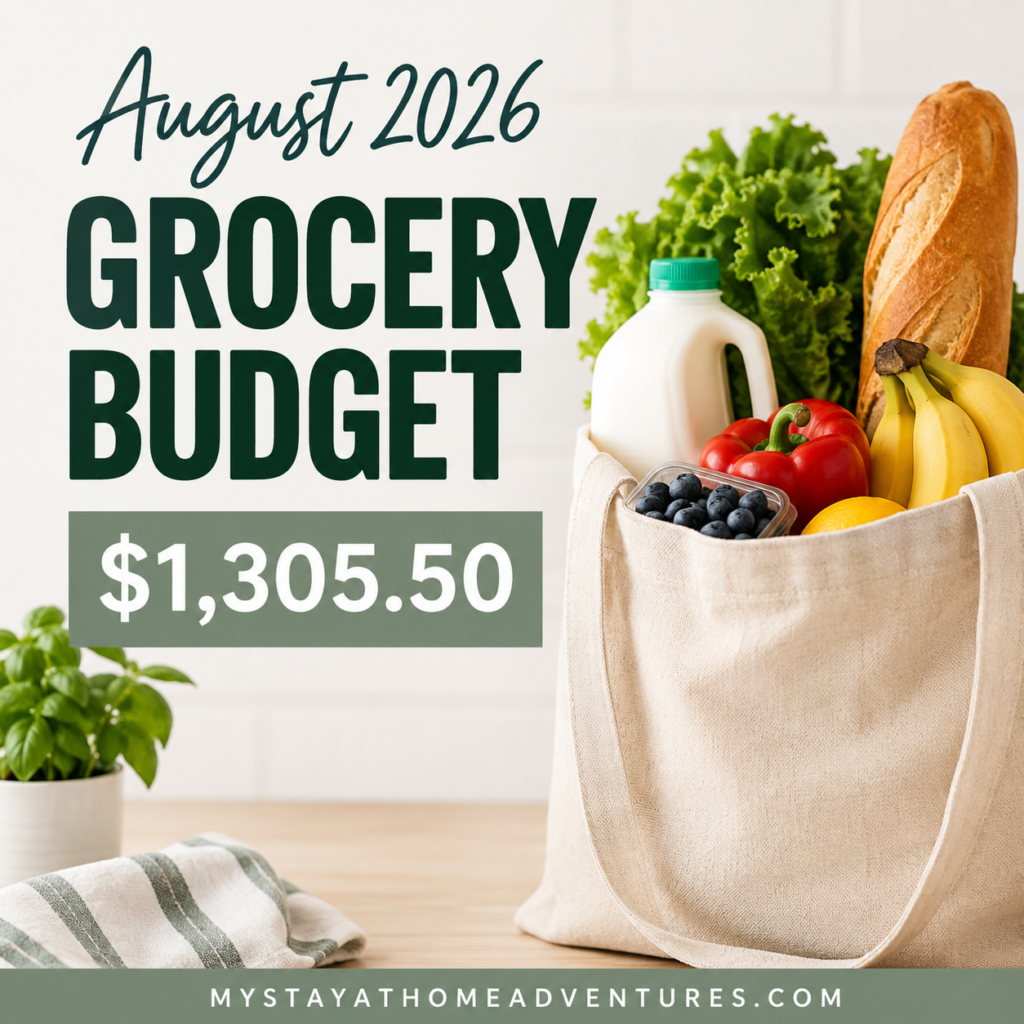
How much did we spend in August 2026?
Our total tracked spending for August was $1,305.50.
Here is the breakdown:
| Category | Amount |
|---|---|
| Groceries | $1,117.86 |
| Household | $138.75 |
| Personal Care | $48.89 |
| Total | $1,305.50 |
I keep household and personal care spending separate from groceries because I want to be able to see what we're actually spending on food instead of lumping everything from Walmart or Sam's Club into one grocery number.
For August, our actual grocery spending was $1,117.86.
We had 219 purchase lines in the spreadsheet, but some of those purchases had quantities of two or more. Altogether, we purchased 278 items during the month.
That is the highest number of items I have tracked in a single month so far this year.
August broke the item record, but not the spending record
This is one of the reasons I enjoy tracking our spending beyond just writing down the monthly total.
August felt like a huge shopping month, and the item count confirms that. But it was not our most expensive month.
Here is how the year looks through August:
| Month | Items Purchased | Total Tracked Spending |
|---|---|---|
| January | 164 | $1,031.31 |
| February | 134 | $879.70 |
| March | 186 | $1,059.48 |
| April | 241 | $1,396.55 |
| May | 214 | $996.41 |
| June | 234 | $1,304.06 |
| July | 198 | $928.41 |
| August | 278 | $1,305.50 |
April is still our highest spending month at $1,396.55, even though we bought 37 more items in August.
June is another comparison I found interesting. We spent $1,304.06 in June and $1,305.50 in August. That's only a $1.44 difference, but we purchased 44 more items in August.
That is useful information to me because the final dollar amount alone doesn't tell me what actually happened that month.
We had finally used up a lot of what I bought earlier this summer
I had been expecting a month like this.
When I stocked up in June, especially on proteins, I knew those purchases would affect the months that followed. If I'm buying meat or pantry staples in one month and using them for several weeks, the next month's grocery total can look lower simply because I'm eating food I already paid for.
Eventually, though, you have to replenish it.
By August, we had worked through a lot of what was in the freezer and pantry. This wasn't one giant shopping trip where I suddenly decided to stock the house again. It happened throughout the month as we realized we were out of things or getting close.
Even our PB&J supplies disappeared, which is a pretty good sign that we had reached the bottom of some of our usual staples.
That doesn't make August a good month or a bad month. It tells me where we were in our grocery cycle.
That's the part of this experiment I find useful.
The kids were still home for most of the month
August was also still summer around here.
The kids were home for most of the month, which means more meals, snacks, and drinks were being eaten at home. We also had some outings, so our normal routine wasn't exactly the same every day.
Then school started in stages.
One of my kids went back on August 24, while two of my other kids started September 1. By the end of the month, I was shopping with September and the school routine in mind even though the purchases still technically belonged to August.
On August 29 and 30 alone, I purchased 53 items totaling $261.93.
Those purchases are part of the August total because that is when I spent the money, but quite a bit of that shopping was preparing us for the beginning of September.
That's another thing I have learned while doing these monthly reports: our household doesn't operate according to a clean monthly reset.
The groceries I buy on August 30 don't suddenly become “August food.” They're sitting there waiting for us to use them in September.
Where we shopped in August
We had 15 store visits or orders during August.
Here is where the money went:
| Store | Amount Spent |
|---|---|
| Walmart | $640.92 |
| Sam's Club | $409.67 |
| Aldi | $173.60 |
| Redner's | $43.99 |
| Target | $37.32 |
Walmart was our biggest store for the month, followed by Sam's Club.
One pattern that continues to show up in my tracking is that when I physically go into a store, I tend to buy more items.
I'm not saying that as a good or bad thing. It's just something I do.
When I'm ordering online, I usually search for what I came for, add it to the cart, and I'm done. When I'm walking through a store, I notice things I forgot we needed, something we're almost out of, or an item I wasn't thinking about when I made the list.
Sometimes that's an impulse purchase. Sometimes it's something we really did need and I simply hadn't written it down.
The useful part is that now I can see that pattern instead of guessing about it.
Why I keep sharing our real grocery spending
The whole point of these monthly grocery budget posts is not to show you what your family should spend.
I don't think there is one number that works for every household. Families are different, food needs are different, prices are different, and life changes from month to month.
I started doing this because I wanted to know what we were actually spending and what was affecting it.
Instead of thinking, “Groceries seem expensive lately,” I can look at the numbers and see what happened.
Did I stock up?
Were the kids home more?
Did I shop inside the store more often?
Were we replacing pantry staples?
Did I buy food at the end of one month that would really be used during the next?
Those are the things I want to learn from this.
If you want to track your own spending, I also have a free grocery tracker you can use. You don't have to spend what I spend or shop the way I shop. The point is to start collecting your own numbers so you can see what is happening in your household.
You can also find all of my previous Real Life Grocery Budget posts here.
Where ChatGPT fits into my grocery tracking
I've also been using ChatGPT for a grocery budget as part of this experiment, but I think it's important to be clear about what that means.
I don't think ChatGPT lowered my grocery spending.
What it has done is help me track it.
I use it to organize purchases, review the spreadsheet, check totals, and help me notice patterns in the information I've collected. August is a perfect example. Looking at $1,305.50 by itself doesn't tell me nearly as much as seeing that we purchased 278 items, had finally depleted some of our earlier stock-up, and bought part of September's groceries before August ended.
But I'm still the one shopping. I'm still making the decisions, putting things in the cart, and spending the money.
The tool helps me make sense of the data afterward.
If you missed July's update, I also shared last month's grocery budget video, which gives you a look at where we were before this much heavier August shopping month.
Our groceries may start looking a little different
There is one more change that started in August that I want to mention because it may show up in future grocery reports.
Our youngest started feeding clinic visits this month.
Because of that, you may start seeing some changes in the foods we're purchasing as we work through that process. There may be foods we try that aren't normally on our list, different versions of foods we already buy, or purchases connected specifically to what we're working on with him.
I don't know yet how much it will affect our grocery spending, and that's another reason I want to keep tracking it.
I'll be able to look back a few months from now and actually see whether anything changed instead of relying on what I think changed.
What August showed me
August was one of our larger spending months, but the most interesting number to me wasn't the $1,305.50.
It was the 278 items.
That's a new record for us, and apparently more than my spreadsheet was prepared to handle. 😂
But when I look at everything happening during the month, it makes sense. The kids were home, our summer stock-up had been used, we were replacing basics, school was starting, and I was already shopping for September by the end of August.
Now I want to see what happens next.
September will be our first month with the kids back in school for most of the month, we're starting with some groceries already purchased in late August, and our youngest's feeding clinic may begin changing what shows up in the cart.
That's why I keep doing this.
Not to chase the lowest grocery number every month, but to track what we're really spending and see what the numbers can teach me about our family.





The groceries I buy on August 30 don’t suddenly become “August food.” They’re sitting there waiting for us to use them in September. 5 Letter Words