Common Lawn Care Mistakes That Can Damage Your Grass
This post may contain affiliate links which might earn us money. Please read my Disclosure and Privacy policies here
A lawn that looks healthy in spring can look significantly worse by midsummer through no fault of the weather or the grass variety — just a series of small, well-intentioned decisions that compound into real damage.
Lawn care mistakes are particularly insidious because the consequences tend to be delayed enough that the connection between cause and effect isn't obvious, and by the time a problem is visible, the underlying issue has usually been developing for weeks.
Most lawn damage traces back to a handful of repeating errors that show up consistently across different grass types, climates, and lawn sizes. Recognizing them before they cause damage is considerably easier than reversing them after they've taken hold.

Mowing Too Short
Scalping the lawn — cutting grass shorter than the recommended height for the specific grass type — is one of the more reliably damaging things a homeowner can do, and it's particularly common among people who mow infrequently and compensate by cutting more aggressively when they do.
The reasoning seems logical: shorter now means less frequent mowing later. The actual result is a stressed lawn that invites weeds, dries out faster, and is slower to recover from heat and drought.
Most cool-season grasses perform better kept at three to four inches during the growing season. Warm-season varieties tolerate shorter cuts, but even these have recommended minimums that many homeowners regularly undercut.
The one-third rule — never removing more than one-third of the grass blade in a single mowing — exists for good reason and applies across most common grass types.
Overwatering and Underwatering
Both watering mistakes are common, but overwatering tends to be more damaging than underwatering in the long run. Grass that's consistently overwatered develops shallow root systems because the roots don't need to grow deep to find moisture.
Shallow roots are more vulnerable to heat, drought, and foot traffic, producing a lawn that appears healthy until conditions change and then declines faster than expected.
Deep, infrequent watering — less often but for longer durations — encourages roots to grow deeper into the soil, producing a more resilient lawn that handles dry periods considerably better than one accustomed to frequent surface moisture.
The general guidance of about an inch of water per week, applied over one or two sessions rather than daily light watering, holds up across most lawn types and climates.
Ignoring Soil pH
Grass takes up nutrients through its root system, and that process depends on soil pH sitting within a range that makes those nutrients actually accessible. Outside that range, fertilizer can be applied in generous quantities and still produce disappointing results because the chemistry of the soil is working against absorption rather than supporting it.
This is where lime for lawns enters the picture most directly — most common turf grasses prefer a soil pH between 6.0 and 7.0, and soils that have acidified below that range don't respond to fertilization the way they should.
Applying lime raises soil pH in acidic conditions, restoring the chemical environment in which grass can actually access the nutrients present in the soil. A basic soil test before adding lime is worth the modest effort, since applying lime to soil that doesn't need it can push pH too high and create a different set of nutrient availability problems.
Applying Fertilizer at the Wrong Time
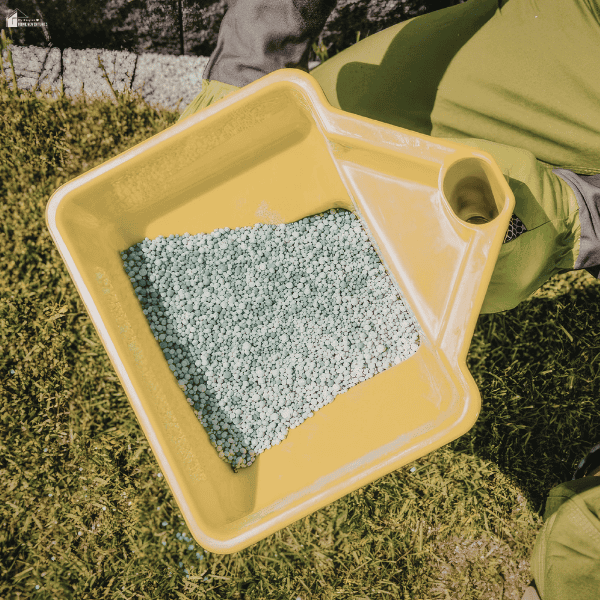
Fertilizer timing mistakes are among the most common and least intuitive lawn care errors. Applying nitrogen-heavy fertilizer to cool-season grasses during summer heat stress pushes growth at exactly the moment the lawn needs to conserve energy, weakening the grass and increasing disease susceptibility.
Applying fertilizer to dormant warm-season grass in early spring, before the grass has actually broken dormancy, wastes the product and can encourage weeds that are actively growing while the grass isn't yet.
Matching fertilizer timing to the active growth period for the specific grass type — fall for cool-season varieties, late spring and summer for warm-season ones — produces better results than a calendar-based schedule that doesn't account for grass variety or regional climate.
Using Herbicides Without Reading Labels
Selective herbicides designed to kill broadleaf weeds work by targeting plant biology that's different from grass — theoretically leaving the lawn intact while eliminating the weeds.
In practice, application errors — concentration mistakes, application during heat stress, treating newly seeded areas, or applying the wrong product for the weed type — regularly produce herbicide damage that looks like disease or drought stress and takes weeks to identify correctly.
Reading the label before application, not after something goes wrong, is straightforward advice that a surprising number of homeowners skip. Product labels provide important instructions that help prevent herbicide damage.
They specify the correct application rate, identify conditions when users should avoid applying the product, and list the grass types that can safely tolerate the treatment. Following these instructions helps protect lawn health and improves treatment results.
Neglecting Seasonal Transitions
What a lawn needs in the spring differs from what it needs in the summer or fall. Timing plays a major role in lawn health. When homeowners aerate and overseed during the correct seasonal window for their grass type, they achieve much better results than when they perform the same tasks at the wrong time.
In contrast, treating every season the same often leads to poor outcomes. For example, thin areas may remain sparse because homeowners overseeded outside the ideal germination period. Likewise, aeration may fail to relieve compaction if the soil is too dry when the work is performed.