How to Add a Hole to a Leather Belt, Watch Strap or Dog Collar at Home
This post may contain affiliate links which might earn us money. Please read my Disclosure and Privacy policies here
Your belt fits best somewhere between two holes. Your watch strap pinches on one hole and slides around your wrist on the next. Your dog is still growing, and the collar has run out of holes. Each time, the fix is one clean new hole, and with the right punch it takes a few minutes.
What You'll Need
Apart from the punch, you probably have most of this at home already.
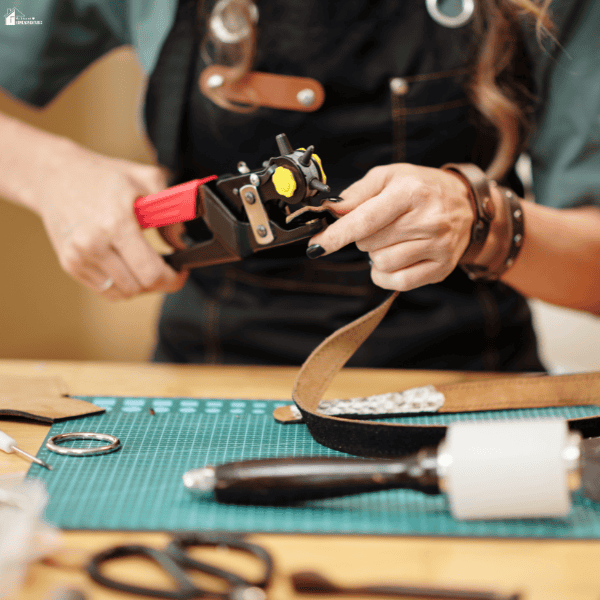
- Revolving leather hole punch: for a belt or a dog collar, get a heavy-duty one. Maun makes a heavy-duty revolving punch (model 2233-200) for leather thicker than 1.5 mm. It has six tubes, from 2.0 mm up to 4.8 mm, so it covers most belt, strap and collar holes. You'll find it among Maun's leather punches.
- Ruler or tape measure: to measure the gap between the existing holes
- Ballpoint pen or awl: to mark the spot for the new hole
- Scrap of leather or an old belt: for one practice hole
- Leather conditioner and a soft cloth: to rub into the leather around the new hole
- Spring bar tool: to take a watch strap off the watch
How a Revolving Punch Works
A revolving punch has two handles and two jaws, like pliers. One jaw carries a wheel with hollow tubes set around its rim, each one a different size, and the other jaw has a flat anvil for the tube to press against.
Turn the wheel until the size you want clicks into place over the anvil, then squeeze the handles firmly in one motion, and the tube cuts a clean round plug out of the leather. On thick belt leather, add a slight twist as you squeeze.
The jaws reach only about an inch and a half in from the edge, which is plenty for a belt, a watch strap or a dog collar. A hole in the middle of a wide piece of leather needs a drive punch and a mallet instead.
Measure, Mark and Choose the Tube Size
Measure the gap between two existing holes, center to center; on many belts it's about an inch. If you need the belt tighter than the last hole, mark the new hole one gap past it. If the right fit falls between two holes, mark the point halfway between them.
Center the mark across the belt, strap or collar, in line with the other holes, and make it a small pen dot or an awl prick.
Hold the tubes up to an existing hole and pick the tube that matches it. If the new hole is too small, the leather tears when you force the buckle prong through. If the new hole is too big, the buckle prong shifts around in it and the hole looks sloppy.
You can't match every hole with a round tube, though. Oval belt holes, holes with metal eyelets and holes bigger than your punch's largest tube need an oval punch, an eyelet setter or a shoe repair shop.
Punch the Hole
1. Turn the wheel until the tube you chose clicks into place over the anvil.
2. Slide the leather between the jaws, good side facing the tube, and set the tip of the tube on your mark.
3. Hold the leather flat and squeeze the handles firmly in one motion, with a slight twist on a thick belt or dog collar.
4. If the little plug of leather stays in the tube, push it out with a toothpick.
5. Push the buckle prong through the new hole and check the fit.
Adding a Hole to a Leather Belt
Put the belt on, pull it to the fit you want and note where the buckle prong meets the leather. If that spot falls between two holes, mark the point halfway between them; if it falls past the last hole, mark the new hole one gap past it, so the spacing matches the others.
Belt leather is often 3 to 4 mm thick. US leather sellers measure thickness in ounces, and 3 to 4 mm comes to about 8 to 10 ounces. Leather that thick takes a firm squeeze, so practice once on a scrap of leather or the very end of an old belt first.
If the tube only gets partway through, keep the punch on the same spot and squeeze again. Then put the belt back on and check the fit.
Adding a Hole to a Watch Strap
Put the watch on, note where the buckle prong meets the strap and mark the new hole as you would on a belt, in line with the other holes. Watch strap leather is thin and the holes are small, so a steady squeeze is enough.
Take the strap off the watch before you punch, so it lies flat in the jaws. If the strap has no quick-release lever on the back, use a spring bar tool to press in the pin that holds the strap to the watch. Then put the strap back on the watch and check the fit.
Adding a Hole to a Dog Collar
Before you mark anything, put the collar on your dog and do the two-finger check: you should be able to slide two fingers between the collar and your dog's neck. Then mark the new hole for that fit, as you would on a belt.
Collar leather is thick, so squeeze firmly. Keep the new hole well clear of the stitching and the buckle end. If you punch through the stitching, you cut the thread and the stitches pull loose. Afterward, buckle the collar on again and repeat the two-finger check.
Finish the Hole
Run a fingertip around both sides of the new hole and smooth down any rough fibers. Then work a little conditioner into the leather around the hole with a soft cloth and wipe off the excess.
Why Not Use a Drill, Nail or Knife?
A clean new hole comes from a leather punch with a tube the same size as the existing holes. The punch lifts out a round plug of leather, so the buckle prong slides through a clean circle. A drill bit catches and twists the leather and leaves a ragged hole, and a heated nail scorches the edge into a hard, dark ring.
If you cut a slit with a knife, the buckle prong stretches the slit open each time you buckle up until the leather tears.
Other Ways to Add a Hole
A shoe repair shop will add a hole for a small charge. You can also set the belt on a wooden block, stand a drive punch on your mark and hit the top with a mallet until the tube cuts through.
For a small hole in thin leather, like a watch strap, an awl is fine: push the point through from the good side until the buckle prong fits.
Frequently Asked Questions
How do I add a hole to a belt?
Measure the gap between two existing holes, mark the new hole the same distance past the last one, and punch the hole with a revolving punch set to match the other holes.
Where can I go to get an extra hole added to my belt?
A shoe repair shop will add the hole for a small charge. Wear the belt when you go so you can point to the right spot.
How do you punch a hole in leather without a leather punch?
For thin leather, push an awl through from the good side. For a thick belt or dog collar, go to a shoe repair shop. Skip the drill, heated nail and knife, which leave a ragged, scorched or torn hole.
How far apart should belt holes be?
Match the spacing of the holes already on your belt, measuring center to center. Many belts use about an inch.