Choosing the Right Garage Door Brand What Actually Matters
This post may contain affiliate links which might earn us money. Please read my Disclosure and Privacy policies here
The garage door market is crowded. Walk through a showroom or browse a manufacturer's catalog and you'll find dozens of product lines, finish options, insulation ratings, hardware styles, and price points that quickly start to blur together.
Most homeowners don't buy garage doors often enough to have developed strong preferences or reference points, which means the choice can feel more arbitrary than it should.
It doesn't have to be. The factors that separate a door that performs well for fifteen to twenty years from one that starts causing problems within five are specific and identifiable. Understanding them makes the selection process considerably more straightforward.
What Brand Reputation Actually Reflects
In the garage door industry, brand reputation is largely a proxy for manufacturing consistency, material quality, and the depth of the dealer and service network behind the product.
A door from a well-regarded manufacturer installed by a skilled technician will almost always outperform a cheaper door from an unknown source not because of branding, but because the tolerances are tighter, the steel gauge is what it's claimed to be, and replacement parts are actually available when needed five years down the line.
Raynor Garage Doors is one of the established names in the North American market, with a product range that covers residential, commercial, and specialty applications.
Their reputation in the industry is built around consistent manufacturing standards and a dealer network that supports both installation and long-term service which matters more than most buyers realize at the point of purchase.
A door is only as serviceable as the parts availability and dealer support behind it.
That's the practical argument for considering manufacturer reputation: not prestige, but the downstream serviceability that a strong brand network provides.
Steel Gauge: The Spec That Gets Glossed Over
Steel thickness is measured in gauge counterintuitively, a lower gauge number means thicker steel. The difference between a 25-gauge door panel and a 24-gauge panel is significant in terms of dent resistance and structural rigidity, but the two numbers look almost identical on a spec sheet if you're not paying attention.
Budget residential doors are typically 25 or 27 gauge. Mid-range doors are usually 24 gauge. Premium residential and commercial-grade doors go to 22 gauge or heavier. For a door that gets regular use in a family home, 24-gauge steel represents the practical sweet spot between cost and durability.
Going lighter to save money tends to produce visible denting within a few years, particularly in homes with active households.
When comparing quotes, ask explicitly what gauge is included. If a salesperson can't tell you immediately, that's informative in itself.
Insulation: R-Value and What It Actually Means for Your Home
Insulated garage doors are rated by R-value, a measure of thermal resistance. Higher R-value means better insulation. The practical question is how much R-value your situation actually warrants.
If your garage is attached to your home, insulation plays an important role. It can improve comfort in nearby rooms and help reduce heating and cooling costs. In these situations, a triple-layer garage door with a polyurethane foam core and an R-value between R-13 and R-18 can provide noticeable benefits.
The requirements are different for a detached garage used mainly for parking. In most cases, an R-6 double-layer door offers sufficient insulation. Higher insulation levels may not justify the extra cost unless the space serves as a workshop or climate-controlled storage area.
Insulation also improves more than energy efficiency. Insulated garage doors are typically stronger and quieter because the foam core reduces vibration. As a result, the door operates more smoothly and produces less noise. This benefit is especially valuable for attached garages located near bedrooms or living spaces.
Style and the Architectural Fit
A door that looks wrong on a house is something you'll notice every time you pull into the driveway, and it affects how the property reads from the street. Style selection is worth doing thoughtfully rather than defaulting to whatever's in stock.
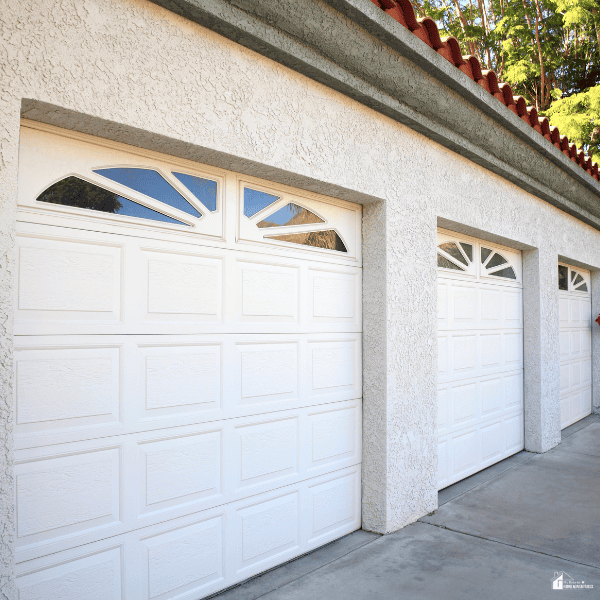
The architectural style of the home is the primary filter. Traditional and craftsman homes suit carriage-house style doors with raised panels, decorative hinges, and hardware that references historical designs.
Contemporary homes look sharp with flush panels, horizontal grooves, or aluminum and glass combinations. Ranch and colonial styles tend to suit raised-panel steel doors in traditional configurations.
Among the residential garage door options available through most dealers, the range now extends well beyond the standard raised-panel formats that dominated the market for decades.
Modern garage doors are available in a wide range of styles. Popular options include flush contemporary panels, woodgrain-embossed steel, full-view aluminum and glass designs, and custom wood doors.
If your home's architecture has a specific look, these styles are worth considering. Many provide the appearance of premium materials while offering greater durability and lower maintenance.
Color is just as important as design. Today, many manufacturers offer factory-applied finishes in a variety of shades beyond traditional white and almond. As a result, homeowners have more flexibility when matching exterior features.
For the best visual impact, coordinate the garage door color with your home's trim, shutters, or front door. This approach creates a cohesive exterior and gives the property a more polished and intentional appearance.
Hardware and Accessories
The visible hardware on carriage-house door handles, hinges, decorative straps is largely cosmetic but has a significant impact on the finished appearance. Quality decorative hardware is zinc or steel with durable powder-coated finishes.
Cheaper versions are stamped from thin material and lose their finish within a few years of UV and weather exposure.
For doors with windows, the glazing option affects both appearance and privacy. Clear glass suits contemporary designs where natural light into the garage is desired. Frosted or obscure glass provides light diffusion with privacy.
Simulated divided lites decorative grille inserts over a single pane give the appearance of true divided light windows at lower cost and with better thermal performance.
The Warranty Question
Garage door warranties cover different components with different terms, and reading them carefully before purchase is worth doing. Panel warranties for painted steel typically run from one year on budget products to limited lifetime warranties on premium lines.
Spring warranties vary considerably; a standard spring may have a one-year warranty; high-cycle springs are sometimes warranted for life.
The installer's labor warranty is separate from the product warranty. On budget installations, labor coverage may last only 90 days. As a result, warranty terms should always factor into your overall value assessment.
A higher-priced garage door may offer better long-term value. Comprehensive product coverage and a reputable installer can reduce future repair costs and provide greater peace of mind. In many cases, stronger warranty protection outweighs a lower upfront price.
Most homeowners keep the same garage door for 15 to 20 years. Therefore, it pays to compare options carefully instead of choosing the fastest delivery or lowest quote. Taking time to select the right door is a smart investment in a feature you will use every day.