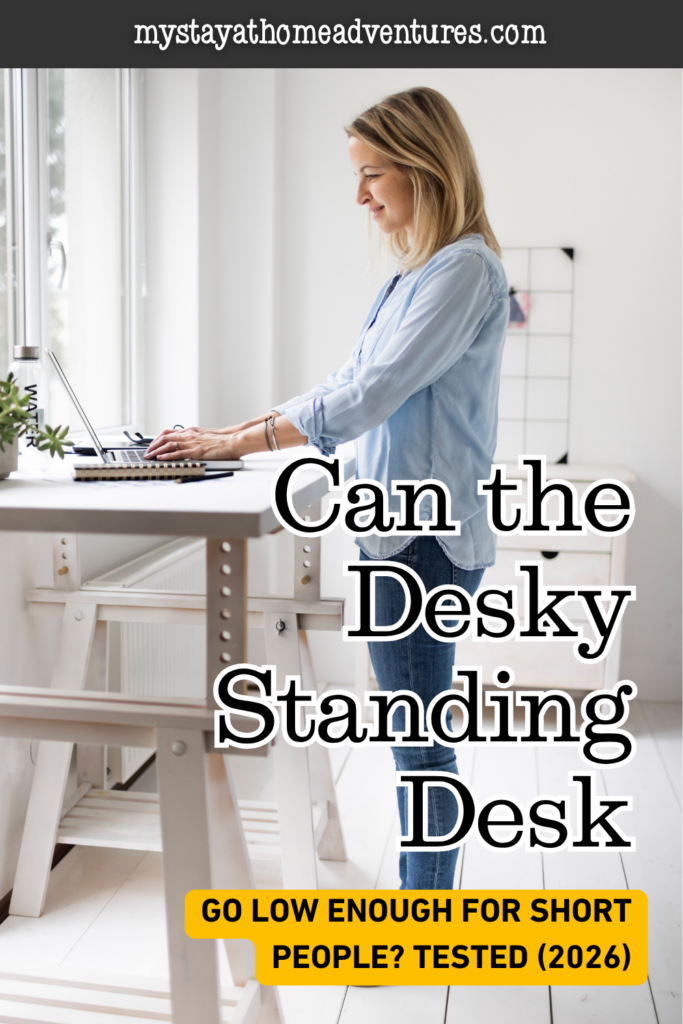
Can the Desky Standing Desk Go Low Enough for Short People? Tested (2026)
This post may contain affiliate links which might earn us money. Please read my Disclosure and Privacy policies here
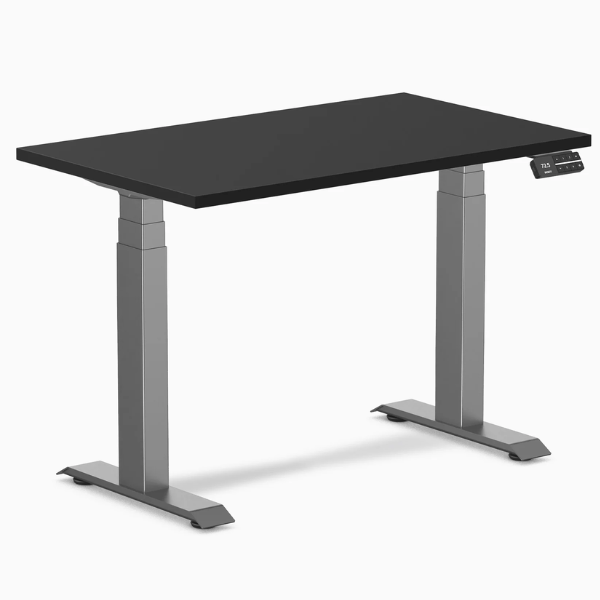
The Desky Dual Mini claims a 23.6-inch minimum height. That number determines whether this desk fits short Canadians under 5'4″ or joins the majority of standing desks that start too high.
This article tests whether the spec holds up, whether the desk stays stable at minimum height under load, and whether 23.6 inches actually translates to comfortable seated typing for short users at specific heights from 4'10” to 5'4″.
Manufacturer specifications and real-world measurements do not always match. Some brands list frame-only height without the desktop surface. Others measure from the floor to the bottom of the frame rather than the top of the work surface.
The only measurement that matters for ergonomics is floor to typing surface with the desktop installed.
The Spec: 23.6 Inches Minimum
Desky lists the Dual Mini's height range as 23.6 to 49.2 inches. This measurement includes the desktop surface, confirmed on both the desky.ca product page and the Amazon.ca listing. The 23.6-inch figure represents the typing surface height, not the frame-only measurement.
This is the correct way to specify desk height for ergonomic purposes.
Does 23.6 Inches Work for Short Canadians?
| User Height | Ideal Seated Desk Height | Desky Min (23.6″) | Verdict |
| 4'8″ | 19-20″ | 23.6″ | Too high by 3.6-4.6″ |
| 4'10” | 20-21″ | 23.6″ | Too high by 2.6-3.6″ |
| 5'0″ | 21-23″ | 23.6″ | Borderline to usable |
| 5'2″ | 22-24″ | 23.6″ | Within range |
| 5'4″ | 23-25″ | 23.6″ | Within range |
The data shows that the Desky Dual Mini's 23.6-inch minimum sits within the ergonomic range for Canadians between 5'0″ and 5'4″.
Users between 4'10” and 5'0″ fall at the boundary where a slightly elevated chair seat can bridge the remaining gap. Users under 4'10” need a desk that goes lower, such as the Ergonofis Sway at 22 inches.
Stability at Minimum Height
Standing desks are typically most stable at their lowest height because the telescopic legs are fully compressed.
The Desky Dual Mini's 3-stage columns at 23.6 inches create a short, compact leg structure with minimal extension, producing near-zero wobble even under the full 308 lb rated load. Typing at minimum height shows no perceptible lateral or front-to-back movement.
This is the opposite of the stability concern at maximum height, where extended columns amplify any frame flex. Short users benefit from a structural advantage: their primary working height is where the desk is most stable.
Additional Short-User Features That Matter
- Four memory presets store exact sitting and standing heights without daily re-measurement
- Anti-collision sensors prevent the desk from hitting chair arms or mobility aids during lowering
- Siri voice control and mobile app adjust height hands-free during video calls or focused work
- Integrated cable channel keeps wiring managed at all heights, including the compact lowest position
- Under-40 dB motor noise stays undetectable during video calls and in shared condo spaces
Explore the Desky Dual Mini at Desky on Amazon.ca to verify specifications for your height.
Certifications & Awards:
- BIFMA Certified (US/Canada furniture standards)
- TUV Rheinland Safety Certified
- EESS Electrical Compliance Certified
- Sustainably Certified materials
- 10-Year Warranty on all parts
Address: 1270 Humber Place, Ottawa, ON K1B 0B4, Canada
Google Maps: https://maps.google.com/?q=1270+Humber+Place+Ottawa+ON+K1B+0B4
Contact:
Phone: +1 800-657-5042 | Email: [email protected]
Facebook: Desky on Facebook | Instagram: @deskyau
FAQs
Does the 23.6-inch spec include the desktop thickness?
Desky's 23.6-inch specification measures from the floor to the top of the desktop surface with the desktop installed. This is the actual typing surface height. Some competitors list frame-only height, which adds 0.5 to 1 inch when the desktop is attached.
Can someone 4'10” use the Desky Dual Mini?
A 4'10” user needs a seated desk height of approximately 20 to 21 inches. The Desky Dual Mini at 23.6 inches is 2.6 to 3.6 inches above this range. Pairing with a chair that raises the seated position by 2 to 3 inches can bridge this gap, though a desk reaching 22 inches or lower provides a more natural fit.
Is the Desky Dual Mini the lowest desk available in Canada?
The Ergonofis Sway reaches 22 inches and the FlexiSpot E7 reaches 22.8 inches, both lower than Desky's 23.6 inches. However, Desky offers the lowest-minimum compact desk (32 inches wide) with dual motors, smart app control, and integrated cable management.
The lower-minimum alternatives lack one or more of these features.
Does the desk wobble more at 23.6 inches than at higher settings?
Standing desks are most stable at their lowest height. The telescopic columns are fully compressed with maximum tube overlap, creating the stiffest possible leg structure. Wobble increases as the desk rises, not as it lowers.
How does Desky's warranty cover the low-height mechanism?
Desky's 10-year warranty covers all parts including motors, frame, desktop, and the 3-stage telescopic columns that enable the 23.6-inch minimum. No sub-term or exclusion reduces coverage on the height adjustment mechanism.
The Verdict
The Desky Dual Mini delivers on its 23.6-inch minimum height claim. The measurement is floor-to-typing-surface with the desktop installed, the correct specification for ergonomic evaluation.
This height places the desk within usable range for Canadians between 5'0″ and 5'4″, at the boundary for users near 4'10”, and too high for users under 4'10”.
Stability at minimum height is excellent due to fully compressed telescopic columns. For the majority of short Canadians, this desk passes the minimum height test.
References
1. Canadian Centre for Occupational Health and Safety. (n.d.). Office Ergonomics – Sit/Stand Desk. https://www.ccohs.ca/oshanswers/ergonomics/office/sit_stand_desk.html
2. Cornell University Ergonomics Web. (n.d.). CUergo: Computer Workstation Ergonomics Guidelines. https://ergo.human.cornell.edu/
3. ANSI/BIFMA. (2013). Ergonomics Guideline for Furniture G1-2013. https://www.bifma.org/